


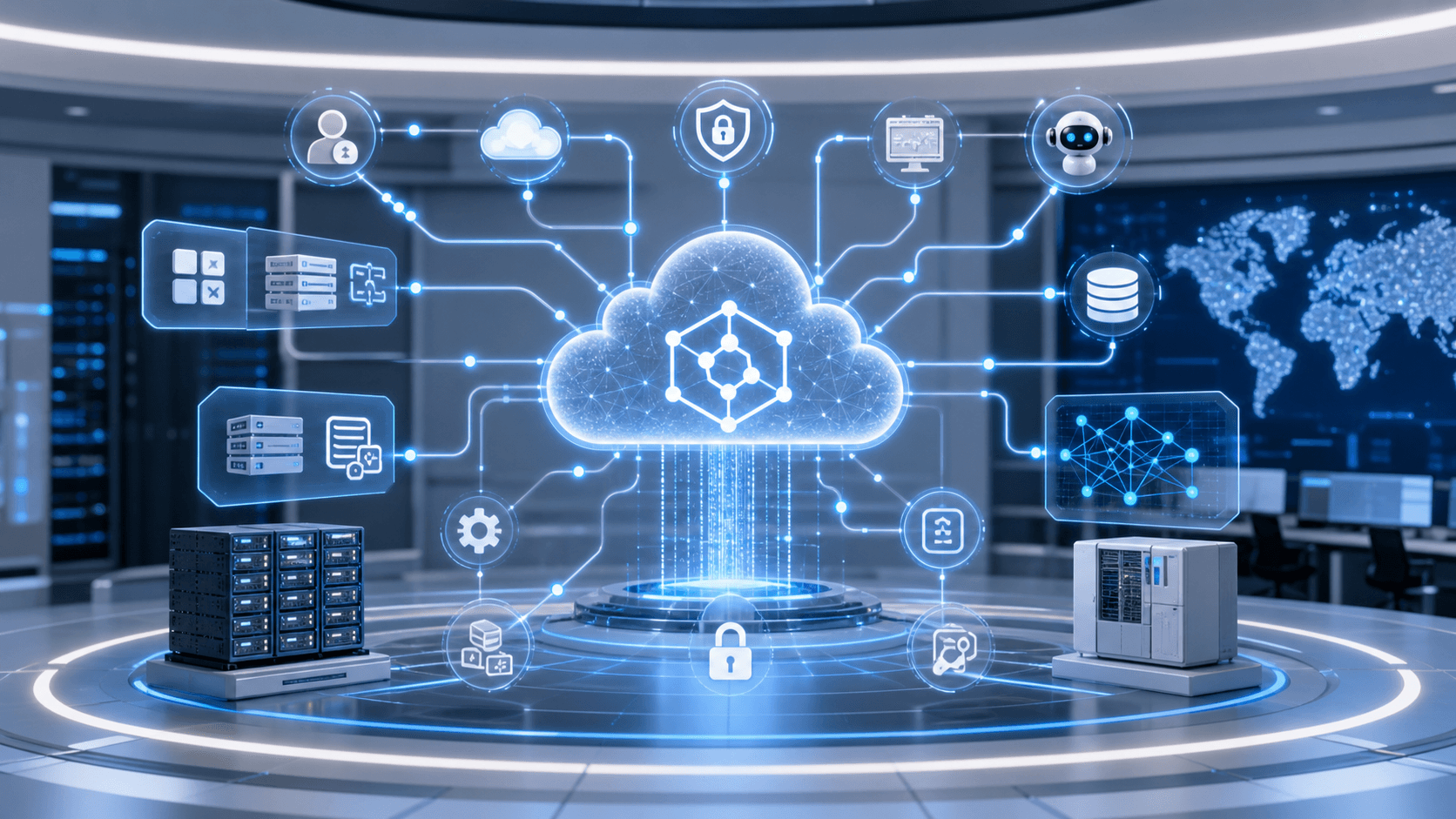
Cloud integration is becoming more important as companies move from AI experiments to operational systems. AI agents and automation workflows need access to data, APIs, documents, identity systems, and business applications. If those systems are disconnected, AI cannot reliably complete work.
AWS describes this modernization challenge directly in AWS Transform, its agentic modernization workbench for mainframe, VMware, Windows, and legacy code. The product framing is notable: modernization is not only about moving workloads to cloud. It is about reducing technical debt and making the stack AI-ready.
Integration Is the Operating Layer
Most businesses run on a mix of SaaS tools, databases, spreadsheets, cloud services, legacy systems, and manual approvals. Cloud integration gives those systems a shared operating layer.
That layer often includes:
- API connections between business platforms.
- Data synchronization across systems of record.
- Event-driven workflows.
- Identity and permission controls.
- Monitoring and alerting.
- Secure data pipelines for analytics and AI.
Once those foundations exist, teams can build automation and AI capabilities that act on current information instead of stale exports.
AI Raises the Bar for Reliability
Traditional integrations move data from one place to another. AI-enabled integrations may interpret information, recommend actions, draft responses, or trigger workflow steps.
That makes reliability more important. Teams need to define:
- Which systems the AI can access.
- Which actions it can perform.
- Which actions require human approval.
- How data changes are logged.
- How exceptions are routed.
- How cost, latency, and accuracy are monitored.
IBM's 2026 AI adoption guidance warns that disconnected systems can create bottlenecks, reduce performance, and introduce security risks when organizations try to scale AI.
Modernization Should Be Incremental
Cloud integration does not require replacing every system at once. A better pattern is to modernize around high-value workflows.
For example:
- Connect CRM, support, and billing data to improve customer response.
- Sync inventory, order, and fulfillment systems for commerce operations.
- Link HR, identity, and document systems for onboarding.
- Connect data warehouse and operational apps for real-time reporting.
- Modernize one legacy workflow before replacing the entire platform.
Each integration should remove a visible bottleneck and create a reusable foundation for future work.
The AI-Ready Cloud Stack
An AI-ready cloud environment is secure, observable, and modular. It gives teams the ability to connect systems, add automation, and deploy AI services without rebuilding the foundation every time.
Key capabilities include:
- API-first architecture.
- Centralized identity and access control.
- Cloud-native monitoring.
- Data governance and lineage.
- Scalable deployment pipelines.
- Clear separation between experimentation and production.
When those pieces are in place, AI projects become easier to scale because the business systems are ready to participate.